

Vellum Review: The Control Room Your AI Stack Needed
You know the vibe. Sales wants a smarter chatbot yesterday. Support wants fewer tickets. Product wants an FAQ bot that doesn’t hallucinate like a sleep-deprived poet. Meanwhile, your prompt spreadsheet has 21 tabs, costs mysteriously doubled, and no one remembers which prompt version actually went live. Fun.
Vellum is the "control room” you spin up when vibes-based prompt editing stops working. It gives you a clean way to design prompts/agents, run real evaluations, ship versioned releases, and actually see what’s happening in production (latency, costs, failure rates, user feedback). Think: moving from guesswork to grown-up AI ops.
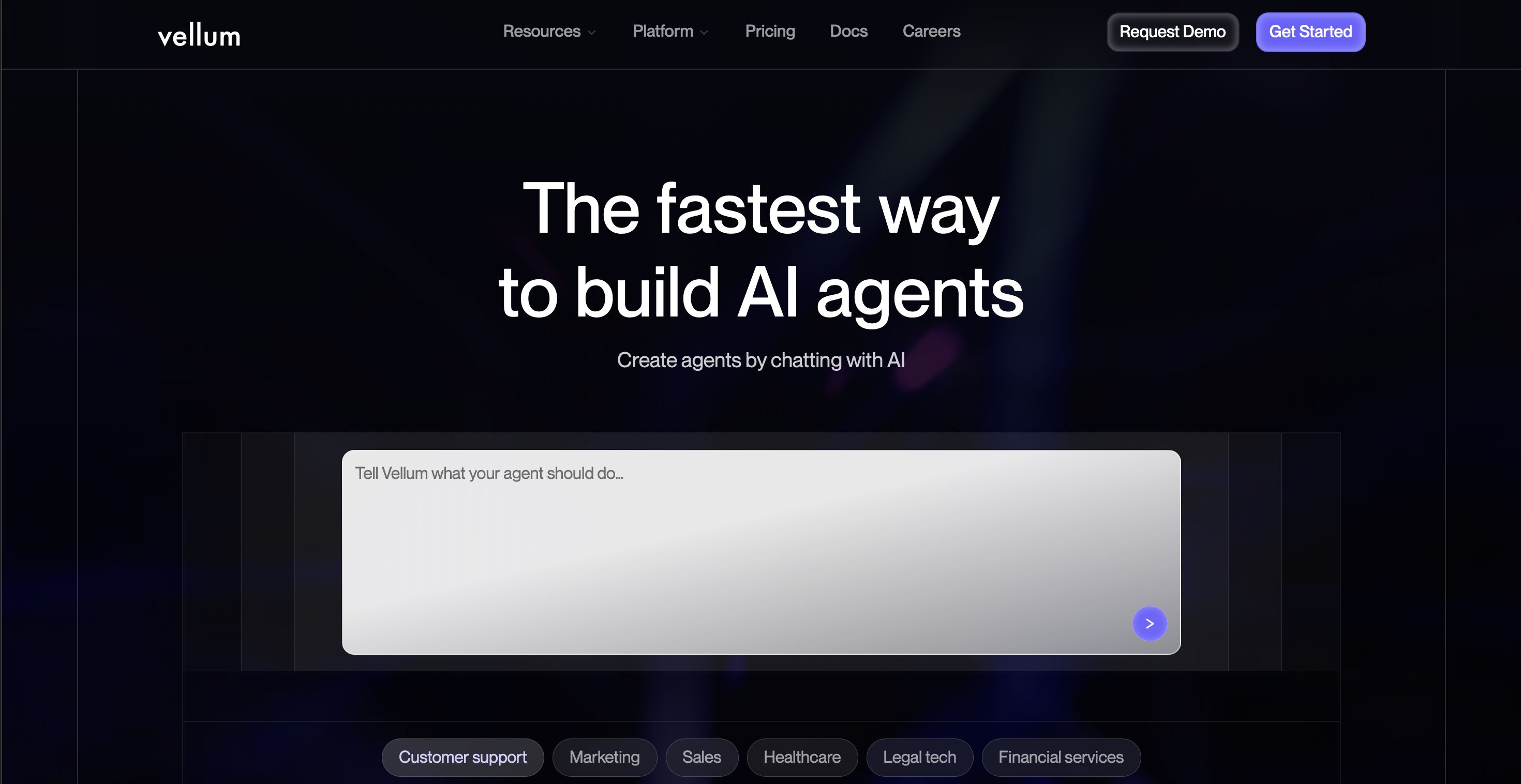
What is Vellum (in human words)?
If ChatGPT is the Swiss Army knife, Vellum is the workshop. Benches, gauges, QA checklists, and the big red "rollback” button you pray you’ll never need. It’s built for teams shipping AI features inside real products, not just tinkering in a notebook.
- Prompt & model playground: Compare prompts across multiple models side by side.
- Workflow / agent builder: Chain steps (retrieve docs, call a model, run code tools, branch/retry).
- Evaluations: Turn "this feels better” into metrics with test sets and online evals.
- Deployments & versioning: Promote new versions safely; decouple AI changes from your app deploys.
- Observability: Trace runs, watch tokens/latency/costs, capture thumbs-up/down, and learn fast.
How it works (the four-step flow)
- Prototype in the playground: Pit prompts and models against each other like a reality show, minus the drama.
- Build a workflow/agent: Stitch together steps—retrieve context, call a model, run a function, branch for edge cases, add retries.
- Evaluate like you mean it: Use a test set of real cases; score for accuracy, tone, or policy adherence. No more "vibes.”
- Deploy & observe: Promote a version, route 10% of traffic first, watch cost/latency, compare v1 vs v1.1, then roll out.
Where it actually helps (use cases you can ship)
- Support deflection: Knowledge-base answers with citations, automatic handoff summaries for tricky cases.
- Sales assist & lead qual: First-pass lead scoring, personalized replies that stay on-brand.
- Document Q&A / RAG: Grounded answers from your docs with guardrails against creative storytelling.
- Policy & comms checks: First-draft reviews for PR/compliance language before humans finalize.
Strengths
- Production-grade workflowing: Branching, retries, sub-workflows—less glue code, fewer brittle hacks.
- Serious evaluations: You get numbers, not hunches, which makes PMs and Legal breathe easier.
- Versioned deployments + rollback: Ship confidently, revert instantly if needed.
- Observability that matters: Traces, costs, latency, and user feedback all in one place.
- Team ergonomics: Product, data, and eng can work in the same control room without stepping on each other.
Limitations (so your expectations are sane)
- Not a "make it smart” button: You still need good data, a solid rubric, and someone who owns eval quality.
- Another tool in the stack: If you’re still in weekend-hack mode, this may be more muscle than you need—yet.
- Pricing clarity varies: Expect a chat with sales for advanced tiers; budget owners will want a crisp usage estimate.
Pricing (plain-English)
- Sales-led tiers common for this category.
- Expect either a free/starter path or a trial to kick the tires.
- Paid plans typically scale by features (workflows, evals, observability depth) and usage (runs/tokens).Tip: Model costs are often the real bill. Use Vellum’s observability to cap runaway prompts and keep finance happy.
Privacy & terms (human summary, no legalese)
- Data handling: Your prompt/runs data is stored so you can debug and improve. Many teams set retention windows to limit how long logs live.
- Security: Standard enterprise expectations apply here—encryption in transit and at rest, SSO/RBAC, audit trails.
- Training use: Common practice in this space is not training public models on your private data by default; confirm this and sign a DPA.
- Compliance: Ask for current security docs (e.g., SOC reports) during procurement and verify region/data residency needs.Bottom line: Treat it like any SaaS handling sensitive content—loop in Security/Legal, set retention, and restrict access.
Is it for you?
Choose Vellum if:
- You’re beyond a single prompt and need repeatable, testable, debuggable AI features.
- You care about rollback-safe deployments and observable costs/latency.
- Multiple teams touch the AI surface (Support, Product, Data, Eng).
Maybe wait if:
- You’re experimenting solo, haven’t touched production, and can live inside one notebook for now.
Alternatives you might peek at
- Langfuse (observability/evals),
- Humanloop (prompt/eval ops),
- PromptLayer (prompt/version tracking).Each has a different center of gravity; Vellum’s strength is the end-to-end feel from prompt → workflow → eval → deploy → observe.
Quick start: a one-week pilot plan
Day 1–2: Pick one flow (e.g., "refund” support replies). Assemble a 30–50 case test set.
Day 3: Prototype two prompts + two models in the playground.
Day 4: Build the workflow with a branch for sensitive intents; add a retry.
Day 5: Run evaluations; pick a winner.
Day 6: Deploy to 10% traffic; watch cost/latency and thumbs-up/down.
Day 7: Compare v1 vs v1.1; ship the winner; write a 1-page retro.
Verdict
Vellum is what you reach for when "we should probably ship this” meets "we should probably not break prod doing it.” It makes AI features measurable, versioned, and observable—which is exactly how business software grows up. If your team wants to move past prompt roulette and into reliable AI shipping, this is a strong, B2B-ready pick.