
Write For Us
We Are Constantly Looking For Writers And Contributors To Help Us Create Great Content For Our Blog Visitors.
Categories
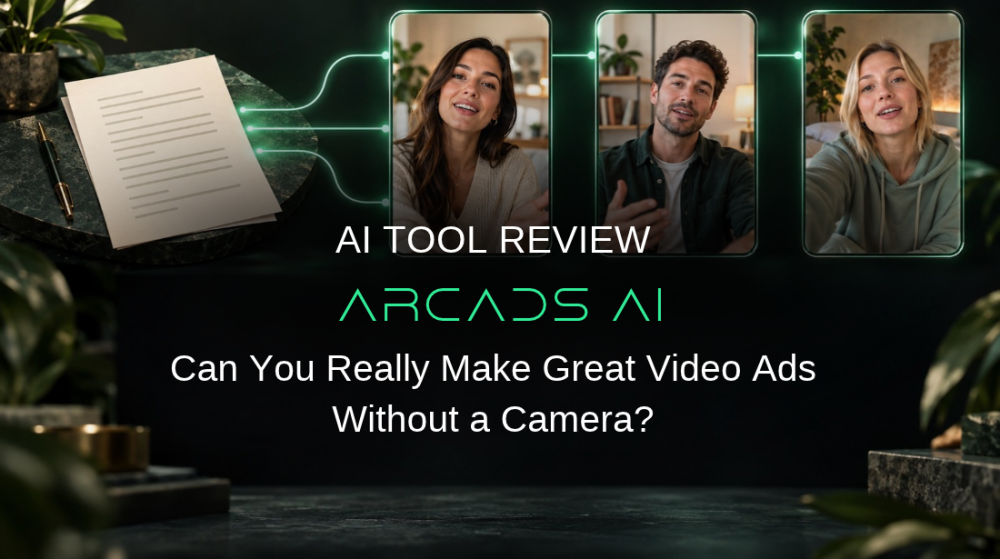
Arcads AI Review (2026): Can You Really Make Great Video Ads Without a Camera?
Arcads AI Review (2026): Can You Really Make Great Video Ads Without a Camera?
Your business needs fresh video ads. Your budget doesn't need another film crew. Arcads promises a shortcut—but the real question is what happens after you press Generate.
It's 11:47 p.m. Your product launch is tomorrow. The website is ready, the checkout works, and your marketing plan has one small problem: you need a video ad, and you have absolutely no video.
Hiring a creator means briefing, scheduling, filming, revisions, and the universally beloved email, "Can we just make the intro a little more exciting?” Doing it yourself means finding decent lighting, becoming comfortable on camera, and discovering that your voice sounds nothing like it does inside your head.
Or—and this is the pitch behind Arcads AI—you could type a script, choose a digital actor, and make an ad without filming anything.
That sounds a bit like giving your marketing team a Hollywood studio in a browser tab. Unfortunately, Hollywood has a way of sending invoices. So, is Arcads a genuine business tool or another AI demo that looks amazing until you need to use it on a Tuesday?
Let's find out.
Our verdict, upfront: Arcads is most interesting for businesses that need to test lots of short-form ad ideas, particularly apps, software products, and performance-marketing campaigns. Its AI actor library, video-generation models, and repeatable workflows are genuinely useful. But credits can disappear quickly, results still need human review, and the terms around generated videos and uploaded assets deserve more attention than the shiny demos get.
First, what is Arcads AI?
Arcads is an AI video ad generator built for the kind of marketing you see while scrolling TikTok, Instagram Reels, or Facebook: someone talking to the camera, showing a product, and trying to convince you to stop scrolling for longer than the average goldfish's attention span.
Its calling card is a library of 1,000-plus AI actors. You pick a face and setting, give that actor a script, choose a voice and delivery style, and the system creates a talking video with synchronized speech and facial movement. Arcads says its library actors are based on real performers who consented to their likeness being used and are compensated for it.
But Arcads is no longer just a talking-head generator. Its current platform brings together image creation, short video models such as Seedance, Kling and Veo, captions, translation, product shots, editing tools, and batch production. It even has a plain-English AI ad assistant called Mark.
Here's the easiest way to understand it: Canva helps you assemble a design. Arcads tries to assemble an advertising shoot. The script is your brief, the AI actor is the presenter, the video model is the imaginary camera crew, and the workflow is the production manager who makes 20 versions before lunch.
The clever part isn't that AI can create a person who talks. We've seen plenty of that. The clever part is turning one ad idea into many variations you can actually test.
The real problem: one ad is never enough
Let's invent a small software company called MinuteBack. It sells a scheduling app for people who have six meetings before lunch and an inbox that appears to reproduce overnight.
MinuteBack wants a 20-second vertical video ad. The founder has a landing page, a product screenshot, and a clear idea of the target customer. What they don't have is a budget to hire five different creators to read five slightly different scripts.
This is the kind of job Arcads was built for. Here's how the workflow would look, based on the company's published instructions.
Step 1: Give Arcads a product and a brief
Start with the MinuteBack website or upload a screenshot. In Arcads Studio, you can bring in images and select the tools yourself. Or you can ask Mark, its AI agent, to help plan the ad. According to Arcads, Mark can read a brand website, build editable brand context, and use that information when writing or generating creative.
A useful brief might be:
Create a 20-second, 9:16 video ad for MinuteBack, a scheduling app for overwhelmed small-business owners. Open with a relatable meeting joke, show the app briefly, and end with a clear call to action. Keep the tone warm and believable. Do not invent customer results or testimonials.
That last sentence matters. "A real customer says this changed my life” is not something an imaginary spokesperson should be pretending is true.
Step 2: Cast the ad—without holding auditions
You could choose an actor who looks like a friendly small-business owner, a relaxed professional, or someone recording a casual video from their kitchen. Arcads offers filters for actors and settings, along with different models for speech and expression.
A possible script:
"Still rearranging meetings like a game of Tetris designed by your enemies? MinuteBack helps small teams find space for actual work. Fewer scheduling headaches. More of your afternoon back.”
This is illustrative ad copy, not a verified customer experience or a claim about an existing product.
Step 3: Generate, then be the picky human
The actor engine creates the talking portion. Other tools can generate a brief app showcase, background footage, subtitles, and a vertical format suitable for social platforms.
Now comes the part an AI demo rarely shows: watch the whole thing. Check the lip sync. Check the pronunciation. Check whether the app screenshot still looks like your app. Check that the actor hasn't developed the emotional range of an airport self-check-in kiosk.
The first render is a draft, not a guarantee. If something looks off, adjust the script, change the model or actor, and render again—while watching how many credits the changes use.
Test casting, hooks, languages, and the "Picky Human" review
Step 4: Turn one idea into a real test
Suppose the first concept looks good. You might want a serious opening, a funny opening, and an opening that focuses on missed appointments. You may also want different actors and an English and Spanish version.
Arcads' Workflows feature is designed for exactly this: connect the production steps once, then reuse the sequence with different inputs. Its documented example turns one script and one product image into 20 short videos across 10 actors and two languages.
That's the little aha moment. Arcads isn't necessarily replacing your videographer for a major brand campaign. It is trying to replace the tedious process of making version 2, version 7, and version 19 of a small ad.
Of course, 20 files are not automatically 20 good ads. Someone still has to decide which are worth publishing—and which deserve to be quietly deleted.
What Arcads actually does well
1. AI actors make on-camera ads less intimidating
Most small companies have plenty to say and nobody who wants to say it on camera. Arcads removes that bottleneck. Its actor library is especially suitable for straightforward, script-led creative: introductions, feature explanations, app promotions, and short offers.
Arcads also supports private custom actors and a clone of your own likeness, subject to permissions and plan limits. This can help keep a recurring spokesperson consistent across a campaign. But consent is not a tiny checkbox to skim past: you need the right to use the face or voice you upload.
The catch: an AI actor may convincingly present a claim, but that doesn't make the claim true. A synthetic presenter isn't evidence that a real customer loved your product.
2. The platform is becoming a whole ad workshop
Arcads now offers more than faces reading scripts. You can generate product and lifestyle images, create video clips using several underlying AI models, make a first-person unboxing from a product image, and turn an app screenshot into a short showcase. It also has tools for captions, resizing, translating, and combining creative elements.
Why do multiple AI models matter? Think of choosing between camera lenses. One model may be better suited to a dramatic product shot; another may work better for a talking person. Arcads packages several choices in the same workspace rather than making a marketer buy and learn each tool separately.
That convenience is useful, although the choices can still be confusing for someone who just wants a 15-second ad. This is where its agent is meant to help.
3. Mark behaves more like a junior creative producer than a chatbot
You can describe what you want to Mark, Arcads' AI ad agent, in ordinary language. Mark can use your website and brand information, suggest creative directions, select tools, and assemble or edit advertisements. The documentation also describes research, scheduled routines, and supported publishing workflows.
That is a meaningful improvement over the classic "select 14 settings and hope” approach. But there's a small pricing detail worth knowing: Mark's conversations can use credits too, even before the final video is generated. Your helpful digital colleague has a meter running.
4. Workflows are where the B2B case becomes convincing
A small brand may need three ads. An agency with ten clients may need 100 variations, with different actors, formats, and languages. Arcads Workflows let you connect steps on a canvas and rerun the production process. In plain English, that's like saving a recipe instead of cooking from memory every time.
For a marketing team, the benefit is repeatability: fewer manual uploads, more consistent output, and a faster way to test hooks, presenters, and markets. The risk is just as obvious: automating a weak idea produces more weak ads, only faster.
5. Multilingual creative is a genuine advantage
Arcads says its talking actors support 74 languages with accents, while video translation offers 176 language and accent options. For a business entering a new market, that's exciting. Making a first Spanish-language or German-language concept no longer necessarily requires coordinating another filming session.
But localization isn't just replacing English words with German ones. Jokes, product claims, accents, and cultural references still need a native speaker's review. An AI-generated ad can cross a border instantly; good taste takes a little longer.
The uncomfortable part: what Arcads doesn't solve
AI-generated doesn't always mean believable
Video models create a plausible-looking scene, not a documentary record of a product being used. That distinction becomes important when the ad contains hands, packaging, tiny labels, or precise screen interactions. Arcads offers product-holding and unboxing features, but customer reports and independent reviews describe occasional visual errors, inconsistent quality, and awkward lip sync.
For a software subscription, a convincing presenter plus a genuine screenshot may be enough. For a skincare bottle, luxury watch, or appliance that must look exactly right from every angle, a real camera may still be the safer option.
The most useful business rule is simple: use AI to generate creative options, not to invent proof of product performance.
The credit system turns experimentation into a cost decision
You pay for generation, not for the number of ads that eventually perform well. That sounds obvious until the fifth version has the wrong pronunciation or your product label turns into a mysterious new alphabet.
Arcads says failed generations are automatically refunded, but a technically successful generation you simply dislike isn't the same thing as a failed job. If your team needs many iterations, budget for more than one take per usable ad.
The customer feedback is mixed—and you should know that
At the time of this review, Arcads' Trustpilot listing showed roughly 2.6 out of 5 stars across 187 reviews. Complaints mentioned credit costs, output quality, cancellations, refunds, and support. There were positive reviews too, including praise for its creative possibilities and responsive individual support agents. Review sites are not a controlled product test, and angry customers can be more motivated to post than satisfied ones. Still, this is enough of a pattern to make a cautious trial smarter than an impulsive annual subscription.
It still needs human judgment
Arcads can help produce ads. It can't tell you whether your offer is compelling, whether your customer acquisition cost makes sense, or whether a synthetic spokesperson is appropriate for your brand. A fast bad ad is still a bad ad. It's just bad in 4K.
Arcads pricing in 2026: what you really pay
Arcads uses credits across its tools and AI models. The company publicly documents credit allowances but says current dollar prices are displayed inside the app rather than on a public pricing page. That matters because third-party price reports and credit allowances have changed over time.
| Plan | Monthly credits in Arcads' current documentation | Publicly reported monthly price | Who it's for |
|---|---|---|---|
| Starter | 8,000 | About $110 (third-party in-app observation) | Trying a small number of ads |
| Creator | 16,000 | About $220 (third-party in-app observation) | Regular testing by one creator or small team |
| Pro | 48,000 | Check in-app price | Higher-volume work, team features, API |
| Scale | 96,000 | Check in-app price | Larger, recurring creative production |
| Business | 192,000 | Check in-app price | High-volume teams and agencies |
| Enterprise | Custom | Sales quote | Custom needs |
Pricing caveat: The $110 and $220 figures were reported from an in-app check dated October 12, 2026, by Predis.ai, an Arcads competitor. Arcads' own help center confirms the current credit tiers but directs users to the app for actual prices. Promotions, experiments, taxes and plan changes may affect your quote. Do not treat the estimates as guaranteed prices.
Here's a more practical way to think about it: Arcads currently lists a basic Arcads 1.0 talking-actor video at 800 credits, for a script of up to two minutes. So Starter's 8,000 credits could cover approximately 10 of those generations if you spend nothing on other charged features. Extra visuals, advanced video models, translations, certain edits, or conversations with Mark can change the math.
If you pay a reported $110 and only five of those ten videos are usable for your campaign, you're effectively at $22 per usable draft, before any extra editing, ad spend, or staff time. That's an illustrative calculation, not a measured Arcads success rate.
See how retakes & Mark agent chats affect your cost per usable ad
One eligibility detail deserves a direct question to sales: Arcads’ help center describes public API access on Pro and above, but its October terms say API access requires a customized offer. Those official statements do not fully line up. Get your intended API access confirmed in writing before buying.
Some useful fine print: Starter and Creator credits reset each billing cycle; Pro, Scale, and Business roll unused credits over. Yearly billing is advertised as 20% cheaper. Higher plans can incur extra usage charges after their credit allowance; lower plans generally stop generating when the pool runs out. Arcads also offers optional spending limits.
Is Arcads free?
Not permanently. The current introductory trial runs for 72 hours with 1,000 credits and requires a payment card. According to Arcads' own documentation, it converts automatically to a paid Starter subscription if you don't cancel before the trial ends. Cancelling during the trial ends access immediately.
So yes, you can try it before paying—but set a reminder before you enter the card details. Your future self will appreciate the tiny act of calendar-based heroism.
Privacy and terms: the 60-second version
Here comes the part of an AI tool review where everyone usually scrolls past. Don't. Arcads' current terms contain a few details that matter quite a lot to businesses.
Your scripts and images
Under Arcads' terms effective October 16, 2026, materials you supply—such as scripts, prompts, images, and client videos—remain yours. However, you grant the company broad rights to use those materials, including rights relating to service improvement, training its AI models, and promoting the service. This is a grant of rights; it does not prove that every upload is actually used for training. If your agency works with confidential product launches or client material, ask for written clarification before uploading it.
Your generated ads
The terms describe a worldwide, non-exclusive license, not a promise that every finished video is exclusively yours. Commercial distribution and advertising uses are permitted within the license. But modifications are subject to restrictions: common additions such as cropping, music, captions, and text are listed, while other types of alteration may require written approval. The terms also contemplate removal of content in certain performer-rights circumstances. Agencies should check the exact rights needed when handing work to clients.
Real people and AI faces
Arcads says its library performers consented to the use of their likeness. If you upload a person or voice yourself, obtaining appropriate consent is your responsibility. The terms prohibit misleading advertising. Don't present an AI actor as a real customer giving genuine testimony when that never happened.
Personal data
Arcads is operated by France-based FRESHR. Its privacy policy, effective September 14, 2026, describes collection of account, billing, usage, and integration data, and sharing with service providers for functions such as hosting, AI generation, and payments. The policy makes narrower no-training commitments for data accessed through specific Google Drive and Dropbox integrations; that should not be confused with a blanket no-training promise for all uploaded creative assets under the general terms.
None of this automatically makes Arcads unsuitable. It does mean the right question isn't only, "Can we generate an ad?” It's also, "Do we have permission to upload the input, and do we have the rights to use the output the way our business needs?”
Arcads vs. the alternatives: which problem are you solving?
Choose Arcads when you need AI presenters, lots of variations, reusable ad-production workflows, and a way for a small team to create creative options quickly.
Consider Creatify when your main starting point is a product listing or e-commerce URL and you want an alternative designed around product advertising. Consider HeyGen when your priority is a polished avatar-led explainer or spokesperson video rather than a high-volume social-ad testing process. Consider a traditional editor such as CapCut when you already have real footage and simply need better cuts, captions, pacing, and polish.
And if your brand sells something where physical demonstration, medical claims, trust, or precise product details are essential? An actual person with an actual camera remains a remarkably useful technology.
Who should—and shouldn't—use Arcads?
Arcads makes the most sense for performance marketers, SaaS and app businesses, e-commerce teams with simple creative needs, and agencies producing frequent ad variations. You don't have to know how to code, though you should be comfortable experimenting with creative tools and tracking costs.
It's a tougher sell if you need only one video every few months, have a very small budget, require exclusive rights to creative assets, need accurate physical demonstrations, or want AI-generated content to stand in for authentic customer reviews.
Start with one narrow, low-risk experiment: a short ad for a non-sensitive product, one or two actors, and a fixed credit budget. Have a real person check every factual claim, every product detail, and every line of dialogue. Then measure whether the finished creative is actually useful, not merely impressive.
Final verdict: Arcads sells speed, not authenticity
The promise of Arcads is appealing because creating video ads has always involved a ridiculous number of moving pieces. Its actor library, multi-model production tools, Mark assistant, and batch workflows give businesses a way to test ideas that used to require a small production calendar and a surprising number of invoices.
But the tool doesn't remove the hard part of marketing. You still need an honest message, a product people want, and the judgment to know when an ad feels wrong. Credits can turn experimentation into an expensive hobby. AI footage can stumble on physical details. And the licensing terms are important enough to read before adopting it for client work.
For teams that need fresh creative every week, Arcads is absolutely worth a carefully budgeted trial. For businesses that simply want one trustworthy, accurate product video, it may be more machine than they need.
The future of advertising might involve fewer cameras. It will not involve fewer decisions.
Arcads AI FAQ
Sources and fact-checking
- Arcads official overview and capabilities
- Official pricing, credits, trial and billing explanation
- Official actor and consent documentation
- Official Mark AI agent documentation
- Official Workflows documentation
- Arcads terms effective October 16, 2026
- Arcads privacy policy effective September 14, 2026
- Predis.ai third-party in-app pricing observation, October 12, 2026 (competitor source; indicative only)
- Trustpilot customer feedback


Subscribe to our Newsletter
 AI IXX Learn
Discover AI.
Learn Faster.
Build the Future.
Download Now!